Immediate Action Needed
Building owners, property managers, facility administrators, and homeowners should not wait for the next scheduled fire sprinkler inspection to address this recall.
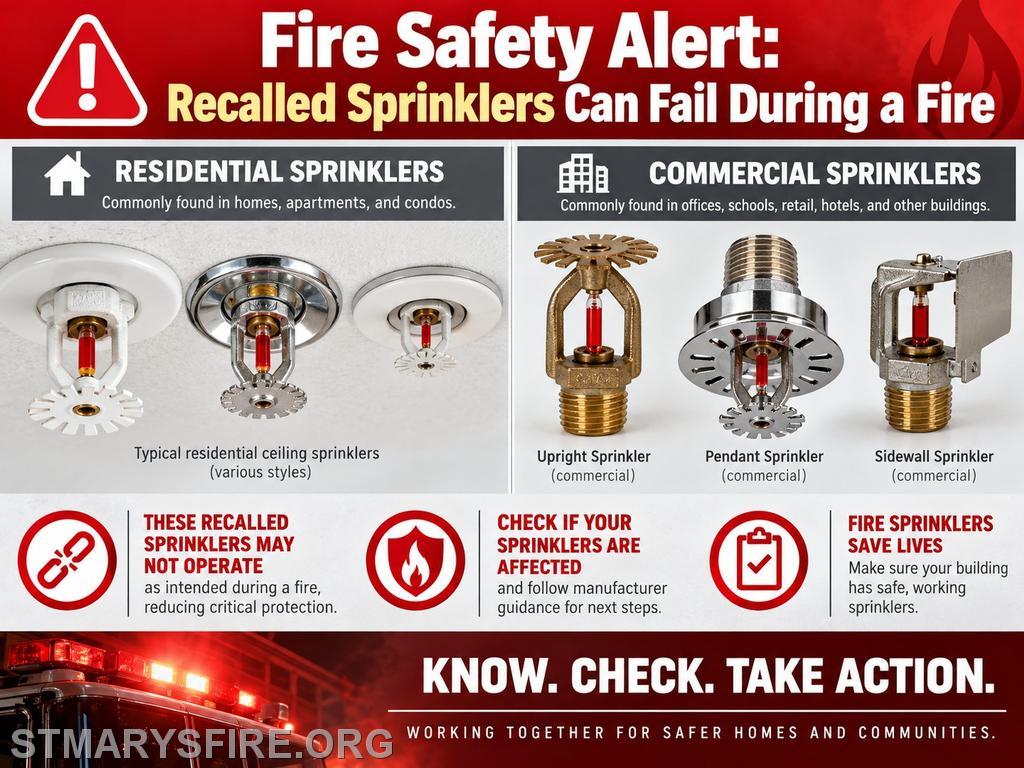
If recalled sprinkler heads are present, they may fail to operate during a fire. Have the system checked by a qualified fire protection professional as soon as possible and replace any recalled sprinkler heads without delay.
Do not shut off, remove, paint, or attempt to test sprinkler heads yourself. Inspection and replacement work should be handled by a qualified sprinkler contractor and coordinated with building management and the appropriate fire officials when required.
The U.S. Consumer Product Safety Commission and Tyco Fire Products LP have renewed a warning urging immediate action to identify and replace recalled fire sprinkler heads that may still be installed in buildings nationwide.
The warning involves certain sprinkler heads manufactured with rubber O-ring seals. Over time, corrosion and exposure to minerals, salts, and other contaminants in water can affect the sprinkler’s ability to operate properly. In some cases, an affected sprinkler head may fail to activate during a fire, reducing or eliminating the protection occupants expect from the system.
The concern is especially important for older buildings, multi-family housing, schools, healthcare facilities, nursing homes, assisted living centers, offices, and other properties where vulnerable occupants may depend on automatic sprinkler protection.
CPSC cited a July 13, 2025, fire at an assisted living facility in Fall River, Massachusetts, where ten residents died and dozens of others were injured. According to the agency, dozens of recalled sprinkler heads remained installed at the facility despite being identified during an earlier inspection.
Sprinklers Included in the Original Recall
The original recall, announced on July 19, 2001, involved approximately 35 million Central sprinklers and about 167,000 additional sprinklers sold under the Gem and Star names. The recall included certain wet and dry sprinklers installed in residential, commercial, institutional, and healthcare occupancies.
|
Product Group
|
Dates Identified in the Original Recall
|
|
Central wet sprinklers with O-ring seals
|
Manufactured 1989–2000
|
|
Central dry sprinklers with O-ring seals
|
Manufactured from the mid-1970s through June 2001
|
|
Gem wet sprinkler model F927
|
Sold under the Gem name 1995–2001
|
|
Star dry sprinkler models listed in the recall
|
Manufactured 1996–1998
|
Potential identification markings may include CENTRAL, STAR, CSC, a “G” inside a triangle, or a star-shaped symbol.
Model information and manufacturing dates may appear on the sprinkler frame or deflector, which is the metal piece designed to distribute water when the sprinkler activates.
A brand marking alone does not confirm whether a sprinkler is part of the recall. Property owners should have a qualified fire protection professional compare the exact sprinkler model with the official recall information.
Recommended Steps for Property Owners
-
Arrange an immediate inspection. A qualified fire protection professional should determine whether recalled sprinkler heads are installed.
-
Review previous records. Inspection reports, maintenance files, and replacement documentation should be checked for earlier findings and any completed corrective work.
-
Replace recalled sprinkler heads. Replacement should be performed by a qualified professional using appropriate listed equipment.
-
Notify responsible parties. Share this information with property managers, homeowners associations, facility administrators, building owners, and organizations responsible for older buildings or vulnerable occupants.
Building owners should request written documentation of all findings and any replacement work, then keep those records with the building’s fire protection system files. If a previous inspection identified recalled sprinkler heads, records should clearly show whether the issue was corrected.
Tenants, residents, and family members of residents in care facilities may forward this notice to management and ask whether the building’s sprinklers have been checked against the recall.
Important Recall Information
The original replacement program ended on August 31, 2007. Older recall announcements may reference free parts and labor, but those descriptions should not be treated as a current offer. The September 2026 notice renews the warning about recalled equipment that may remain in service. Owners should review Tyco’s current guidance and discuss replacement arrangements and costs with their sprinkler contractor.
Routine inspection, testing, and maintenance remain essential for all fire sprinkler systems. NFPA 25, Standard for the Inspection, Testing, and Maintenance of Water-Based Fire Protection Systems, provides requirements for maintaining these systems. Testing and replacement schedules can vary based on the sprinkler design, age, and environment.
Property owners should work with their sprinkler contractor and local fire code official to confirm the requirements for their building. A future routine inspection or testing date should not be used to delay action on recalled sprinkler heads.
Do Not Disable Fire Protection Systems
Residents and property owners should not shut off a sprinkler system or attempt to remove sprinkler heads themselves. Any work that temporarily places a fire protection system out of service should be coordinated by the sprinkler contractor, building management, and appropriate fire officials.
The Home Fire Sprinkler Coalition also reminds occupants to keep sprinklers free from paint, hanging objects, decorations, and storage that could block water distribution during a fire.
Fire safety reminder: Fire sprinklers remain an important part of fire protection when properly installed, maintained, and inspected. Residents should also maintain working smoke alarms in every bedroom, outside each sleeping area, and on every level of the home. Test alarms monthly and follow the manufacturer’s instructions for replacement.
This safety notice is provided for public awareness. Property owners should consult qualified fire protection professionals, local code officials, and the manufacturer’s current guidance for inspection and replacement requirements.